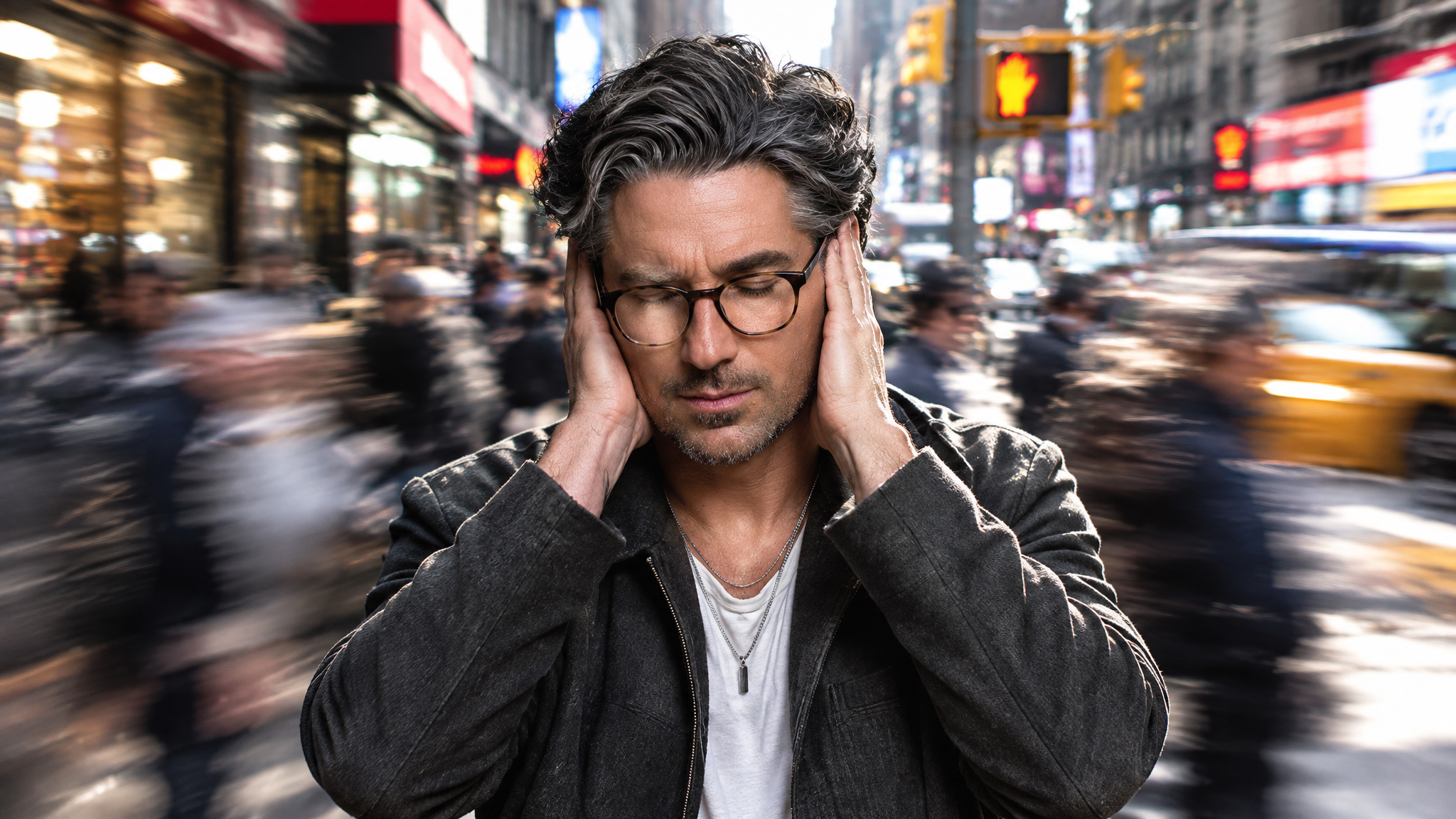
For two years I have documented what algorithms do to the people who perform for them. Then the people sending me audition tapes began describing something autism research had already named.
Some of them sent twenty minutes.
I had opened casting for the second part of my documentary series, Project Algorithm Burnout, and asked for an audition video. I was specific about the story I wanted: where the displacement from yourself started, when productivity became your identity, when your self-worth started being calculated instead of felt. The call went out across the country and overseas, to content creators, founders, artists, marketers, and entrepreneurs: people whose careers run through their phones, and who know better than almost anyone how quickly an audience stops watching.
I had told them the deeper down the rabbit hole, the better. I didn’t expect so many of them to take me at my word. They apologized for running long. Then they kept going. Alone with a camera, with no number to hit, they sounded nothing like the people on their own accounts. The polish was gone. What remained was halting and unguarded: people describing a version of themselves they put on every day and no longer recognized, a creative instinct they once trusted that had gone quiet, and an exit they couldn’t take because their income depended on the performance.
Across two rounds of casting, I have now watched or talked with more than 350 people, and they keep coming. Watching them, I began to suspect that one of the most revealing things in these tapes might not be anything the participants said. It was how differently they spoke when no algorithm was measuring them. And some of them were describing something I’d never asked about at all.
Twenty years inside the machine
I should have seen it sooner. For twenty years I built brand identities for a living: the voice, the look, the story a company or a founder tells so that people, and increasingly the algorithms deciding what people see, will recognize them. I was good at making a self legible to a system. Somewhere along the way I noticed the tools were working on the builders, too. It took me longer to notice they were working on me.
I watched entrepreneurs refresh their analytics dashboards dozens of times a day, not because the numbers changed that fast, but because their sense of self was tethered to them. When the metrics were up, they felt like they existed. When the metrics fell, they felt like they were disappearing. That is not business strategy. It is identity maintenance.
So I started documenting it. The first part of the series, filmed in New York with seven cast members, became a documentary. There’s also an eighteen-episode podcast, and through it, messages began arriving from strangers before anyone had asked them anything:
When did I stop posting because I wanted to and start posting because I’d feel invisible if I didn’t?
How do I explain to someone that I’m exhausted when I haven’t actually done anything — I’ve just been monitoring?
I gave the pattern a name: algorithm burnout. Not exhaustion from doing too much, but exhaustion from being someone too long. My casting call said as much. I thought I understood what I was documenting: an identity problem, the occupational hazard of a new kind of work.
That was my theory when the second round of tapes began arriving.
It turned out to be only half of the picture.
The word nobody asked about
The first thing that caught me off guard was how exact they were. They weren’t describing too many hours or too many posts. Ordinary burnout is a problem of volume. This was a problem of selfhood, which is what I had asked about, but I hadn’t expected it to arrive with such precision: the rehearsed self, the constant monitoring, an exhaustion no amount of rest seemed to reach, the sense of performing a person they could no longer find underneath.
It was the same tiredness strangers had been writing to the podcast about: exhausted without having done anything, from watching the numbers and watching themselves.
The second thing that caught me off guard was me. The language was familiar, and not from my research. The first mask I ever studied was my father’s. To most people he was magnetic: well-spoken, charming, able to warm a room of strangers with nothing but confidence and cadence. At home we saw the aftermath. He would retreat, not in anger but in depletion, as if the version of himself the world admired cost more than he had.
I was maybe eight when I asked him at dinner about his day and watched his fork pause mid-air before he changed the subject, smoothly, expertly. I learned to read the tells early. The tuition, as I wrote in my book Algorithm Burnout, was paid in childhood.
I also learned the performance. I could make people feel seen long before I knew how to be seen myself. And I’ve always known a particular kind of tiredness. It feels as if everyone else is on cruise control while you’re shifting gears by hand, and not on the highway but on the simplest stretches: the small talk, the dinner party, the room where everyone else’s social navigation runs automatically and yours runs on conscious effort.
I’d never heard people who lived on cruise control describe it. Now, tape after tape, they were describing what it’s like to drive stick.
Then some of them named it.
Nothing in the casting call had mentioned autism. I had asked about identity, performance, and self-worth. I had not said a word about masking, neurodivergence, or the spectrum. But a number of applicants used exactly those words, words I had never put there. That was what made it impossible to dismiss.
Then the pattern snapped into focus, along with the reason it had felt so familiar. What these people were describing, many of them without a word for it, was the texture of a life I knew from the inside.
I went to the research after the pattern appeared, not before. Autistic adults, and the researchers working alongside them, had already named what I was seeing. In 2020, a study built with autistic participants defined autistic burnout as pervasive exhaustion, loss of function, and reduced tolerance to stimulus, brought on by the chronic strain of a world that doesn’t fit. One participant’s description gave the paper its title: every internal resource exhausted, with “no clean-up crew.”
Researchers point to masking as a major contributor: the sustained work of hiding who you are in order to pass. Reading it felt less like discovering a new idea than like finding the other half of a map.
That’s the symmetry at the center of this story. A cost the autism community has described for decades, the cost of performing the self the world demands, is now appearing, in strikingly similar terms, in people whose livelihoods depend on performing for algorithms. And it may help explain something happening in plain sight: why so many people who have never been evaluated are recognizing themselves in autism.
It still left the hardest question open: why now, and why so many?
The recognition question
Part of the answer is visible on the platforms themselves. Autism has become one of the biggest health conversations online. When researchers studied TikTok, videos tagged #autism had drawn 11.5 billion views. Among the creators are autistic people describing masking, burnout, and the daily work of passing in a world that wasn’t built for them. And many of the people I’ve heard describe themselves in that language have never been evaluated.
Researchers have started to name what happens next. A 2025 study in New Media & Society described TikTok as a site of “algorithmically mediated biographical illumination”: the algorithm doesn’t just show people autism content, it helps shape how they come to recognize themselves in it. The content isn’t always right, either. Of the most-watched informational autism videos on TikTok, researchers judged 41 percent inaccurate and another 32 percent overgeneralized.
The public argument has two sides. One says this is overdue self-discovery: autistic adults, many of them women, who were missed as children and are finally finding language for their lives. The other says it’s misinformation: ordinary distress relabeled as autism by vague content. I think there is a third possibility, and it’s the one my tapes kept pointing to. The platforms may be producing, in people who aren’t autistic, the very experience the content describes: the masking, the connection that has to be computed rather than felt, the exhaustion of keeping a performed self alive. Then they serve up the vocabulary for it. The environment imposes the mode. The culture names it.
Consider how the people in my tapes live. They built careers, kept friendships, and learned to present themselves inside systems that measure every interaction. Performing a legible, consistent, optimized self stopped being a skill. It became a condition of work.
I want to be careful here. Many people who recognize themselves in autistic creators’ work are autistic, and for adults who can’t get or afford an assessment, self-identification is often the only way in. Their recognition is real. My claim is narrower: somewhere in that audience are people whose recognition is accurate about the experience and mistaken only about its source.
This is a different question from the rise in clinical diagnoses, which has well-documented causes of its own: growing awareness, fading stigma, broader criteria, and a generation of autistic women who were overlooked as girls. A widely reported 2024 study found that recorded autism diagnoses among 26-to-34-year-olds in U.S. health systems rose 450 percent in just over a decade. That figure counts people in clinics. What I am describing mostly lives outside them.
Even within clinical research, the environment is part of the conversation. Will Mandy, a clinical psychologist at University College London, has argued that rising diagnoses reflect a growing mismatch between autistic traits and modern environments, not a change in underlying neurobiology. I would put it more simply: the environment is reshaping the self, and the self is paying for it.
Algorithm burnout and autistic burnout share an engine
The mechanism is one autistic adults know intimately. It’s called masking, and it isn’t unique to autistic people. A 2024 study of a representative sample of 972 American adults found camouflaging to be a shared social coping experience across the general population, autistic people included. And in that same sample, camouflaging tracked with many of the mental health strains previously reported in autistic people, though the evidence isn’t uniform and autistic people may feel the costs more intensely. One way to frame the difference is motive. Autistic people tend to mask to survive. Everyone else tends to mask to get ahead.
The algorithm quietly erased that distinction. If your income depends on being visible, go quiet and your reach falls, and your clients stop finding you. Getting ahead turned into getting by. The sociologist Erving Goffman argued in the 1950s that all social life involves performance. But Goffman’s actors could leave the stage. The feed offers no wings, no backstage, no intermission. The performance is continuous, recorded, measured, and paid.
The performance doesn’t stop at the screen, either. At a dinner party in Los Angeles, around a table of some of the most talented creative people I know, everyone looked exhausted, and everyone was calibrating their performance to everyone else: a brightness in the eyes just slightly too consistent, a laugh that arrived a beat too quickly. I recognized it because I was doing it too.
Algorithm burnout is not autistic burnout, and conflating the two would erase something real. But they share an engine, and the engine is masking: the effortful, unrelenting maintenance of a self, inside a system that rewards the act and penalizes its absence.
The condition is not being replicated. The cost is.
The parallel runs deeper. Researchers studying autistic burnout have described “dual masking”: hiding your autistic traits, then hiding the burnout that the hiding produces. The platform version is familiar to anyone who scrolls: feeds full of wellness and productivity, posted by people quietly coming apart offline. I grew up watching the analog version. One person who wrote to my podcast put it better than any definition:
Why can I perform confidence for ten thousand strangers and then sit in my car afterward and not recognize myself?
A self that has to be rebuilt every day
The deeper I went, the stranger the mechanics became. The popular story about social media treats the like as a slot-machine reward: it feels good, so we chase it. If you’ve ever refreshed a post more times than you’d admit, you know that’s not the whole story. What I heard in the tapes looked less like people chasing pleasure than like people holding themselves together.
Each spike in engagement briefly answers a question the performed self can’t answer on its own: am I real, am I valued, do I belong. Then the answer fades, and the self has to be rebuilt. In a paper I have written on this, I describe it this way: the hit is not pleasure. It is structural integrity.
I think that’s what I was watching in those twenty-minute tapes: people with no metric measuring them, the scaffolding briefly down, finding out what was still standing.
You’ve probably heard the obvious advice: just log off. Maybe you’ve given it to yourself. Here’s why it so rarely works. Once a career, an income, and a reputation rest on the performed self, the mask becomes load-bearing. In a landmark analysis of 208 stress studies, the conditions that produced the body’s largest cortisol response, and the slowest recovery, were those in which people were judged by others in circumstances they couldn’t control. That’s a close description of the feed.
Taking off the mask does not feel like liberation. It feels like annihilation. And those who do step away often describe something autistic adults report after burnout: when they try to return, they can no longer perform the way they used to.
Even rebellion gets absorbed. A creator who breaks down on camera discovers that the algorithm rewards the breakdown, and then demands that it become the brand. Vulnerability becomes a content lane. The person who finally got real learns they have simply been issued a new mask.
None of this is autism, but much of it would sound familiar to many autistic people, who describe the peculiar exhaustion of being accepted without being known. A metric can confirm that a performance landed. It can’t confirm that the person behind it was seen. Acceptance is not belonging. It is a performance review.
We have a word for going viral. We have no word for what happens between two people in a room when neither of them is performing, and that may be exactly what is being lost.
The double empathy problem, turned around
There’s a name for why this gap hurts so much, and it comes from an autistic researcher. In 2012, Damian Milton proposed what he called the double empathy problem. The older view held that autistic people carry a one-sided deficit in understanding others. Milton argued that misunderstanding runs both ways: when people whose minds work differently meet, each struggles to read the other. The difficulty lives in the gap between them.
Many autistic people have spent their lives on the harder side of that gap, living by social rules written for a different kind of mind and paying for it in exhaustion. The platforms added a new kind of mismatch, this time between people and a system, and rewrote the rules. Social life became explicit numbers, visible scores, and reach you can measure. That rulebook wasn’t written for how most people think either. Now it’s the majority living by rules that don’t match their minds, masking to keep up, and burning out.
This is also why “everyone’s a little autistic” is wrong, and why it lands as an insult. Autism is a whole way of being, across a wide range of support needs. What is shared here is the cost of masking, not the neurology. If I’m right, autistic people will recognize this before anyone else. Many have been living a version of it since childhood.
The limits of what I know
Before I go further, a word about what I’m not claiming. I’m not claiming that phones cause autism. The national argument over autism’s causes has become a political fight, and the environmental theories at its center are biological. Mine is behavioral: the environment I’m describing doesn’t change anyone’s neurology. It changes what is demanded of it, all day, every day.
Some of the people in my tapes may well be autistic, coping until the demands outgrew them. Others may be carrying the cost of masking without being autistic. From the outside, no one can yet tell them apart. Neither group deserves to be dismissed. Telling them apart is the question.
What I have is a hypothesis, drawn from more than 350 casting tapes and conversations, reviewed by me alone, with no control group and no tally of how often each pattern appeared. My casting call asked about identity, performance, and self-worth, so much of what people told me was an answer to my own question. What it never mentioned was autism. Other forces are surely at work. That’s enough to raise the question, not to answer it.
The answer is testable: measure people whose work depends on platforms against people whose work does not, using the tools researchers already use for masking and autistic burnout, and watch what happens when platform dependence eases. A simpler first test is sitting in public view: count how often the people in the comment sections under the most-watched autism videos, the ones saying “this is me,” also mention their work and their feeds. The full argument, with its limitations, is in a paper I have submitted as a preprint.
The people best placed to tell me whether this rings true, or where it’s wrong, are autistic. If you’re one of them, I want to hear it. Find me on Instagram at @algorithm.burnout or on YouTube at @AlgorithmBurnout, where the docuseries is unfolding in real time. Part 1 is there now.
And if you recognized yourself anywhere in this story, whether or not you identify with autistic traits, I want your audition. Casting for Part 2 is still open, and the ask is the same one that started all of this: tell me about your relationship to algorithmic pressure and creative identity.
The generation without a before
If you’re old enough to remember life before the feed, you know what I mean by this next part. The people in my tapes have something to lose because they had something before. They remember when a decision could be felt rather than calculated, when connection didn’t need a number to register. That memory is part of what makes their exhaustion so painful: they haven’t only been changed, they can measure the distance.
In 1960 the psychoanalyst D. W. Winnicott described the “false self”: a compliant persona a child builds to meet the demands of its surroundings, one that performs well enough but never becomes a felt identity. What Winnicott observed in the nursery, the feed has industrialized.
Each generation now enters the feed earlier, with less of a self already formed. What I’m documenting in adults is acquired, learned under pressure and perhaps reversible. For children growing up inside the same architecture, it may not be a mask worn over a face. It may be a face that never formed without one.
A marketing executive in her thirties once wrote to my podcast. By every visible measure, her career was working. I’ve achieved everything I set out to achieve, she wrote. And I have never felt less like myself.
She still remembers who she was. The question now being asked in clinics, in comment sections, and in audition tapes that run twenty minutes long is whether anyone will notice what changed around this generation before the next one grows up with nothing to remember.James John Buzzacco is a director, writer, and brand strategist who spent twenty years building identities for brands before turning the camera on what that work does to people. He is the founder of Creative Doorway and Algorithm Burnout, LLC, the director of the docuseries Project Algorithm Burnout, and the author of Algorithm Burnout: Reclaiming Your Identity from the Mechani