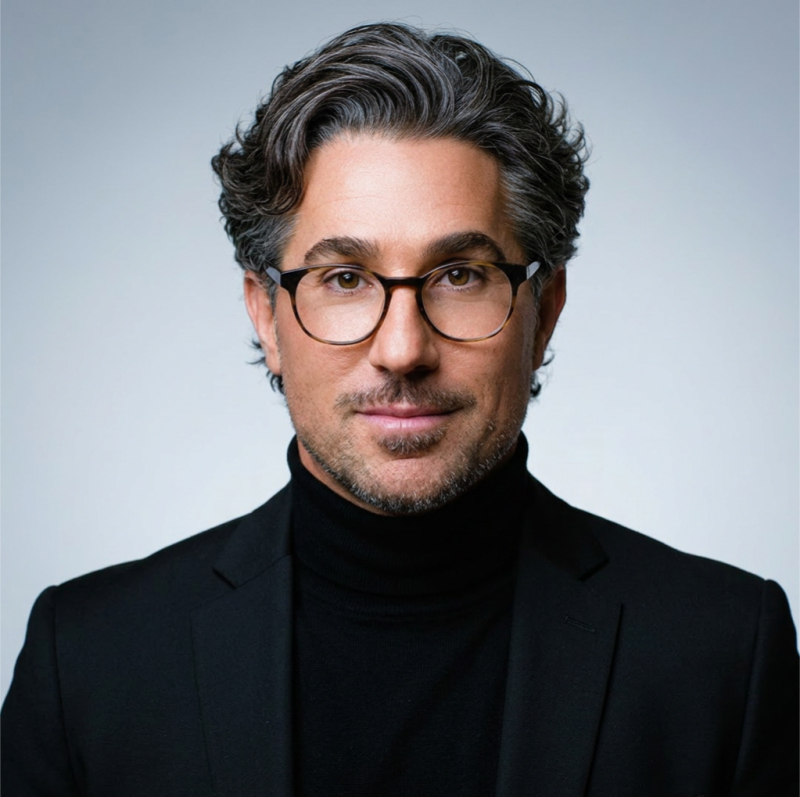
He spent twenty years building identities for other people. Then he discovered the algorithm was dismantling them — including his own.
What he found when he went looking already had a clinical name. In a field nobody thought to look in.
Adult autism diagnoses have risen 450%. The autism hashtag has 11.5 billion views. Everyone's arguing about why. A two-year investigation found an answer nobody's proposed — and it starts with the device in your hand.
He spent twenty years building identities for other people. Then he discovered the algorithm was dismantling them — including his own.
What he found when he went looking already had a clinical name. In a field nobody thought to look in.
I'm James John Buzzacco. My brain is a computer science brain — calculus and physics spoke to it in a way most things didn't. But there was a restlessness underneath that wouldn't optimize away. Questions that didn't have tidy answers. I found what I was looking for in story — in the work of understanding why someone does what they do, not just how.
I went after it. Agencies and broadcast production first, then Los Angeles. Over twenty-plus years I directed brand story campaigns for people and businesses whose livelihoods depend on the algorithm. Production partner with Droga5 on Michael Phelps and the Olympics. But the deeper I got, the more I saw a gap between what I was building and how I believed stories should be told. I wanted to go further — past the campaign, past the brand, into the person underneath. My wife and creative partner Misty and I built the place to do it — Creative Doorway — our own studio, our own rules, one idea at the center: the authentic human story is the only one worth telling.
That philosophy carried everything — the awards, the success, and the reason our clients stayed five years or more. Jim Morrison, former President of L'Oréal, hired us eight years ago to build the brand for his new beauty biologics company — and never left. That kind of retention means you learn how someone actually thinks — what they trust, where their instincts live, the voice they lead with when nobody's watching. We built campaigns around those instincts. That was the whole job.
I watched brilliant people — people whose instincts we'd built entire brands around — trade their relationships, their health, their peace, just to keep the illusion of the image they'd built online going a little longer. Chasing visibility and engagement until they couldn't make a decision without checking what the algorithm would reward first. These were people I knew deeply. People I'd sat across from for years. And I was watching them lose authority over their own voice.
Then AI hit the industry, and whatever I'd been watching for years accelerated until I could see it happen in weeks.
And it was happening to me too.
I couldn't remember who the dreamer was under all the constant conforming being asked of me. What was once rewarding — creatively, spiritually even — had turned into pure methodical survival.
The authentic human story is the only one worth telling. That was the whole idea.
Moved to Miami. Kept the studio running but turned our attention to what we couldn't unsee. I was recovering from the same thing I'd watched consume everyone around me. Finding my own instincts again. And then trying to understand what had taken them.
I called the framework Algorithm Burnout. Not fatigue from doing too much. Exhaustion from being someone too long — internal identity displacement caused by performing a constructed self for algorithmic approval.
The framework was built around a specific observation: the same tools used to construct brand identities were reshaping the people building them. The displacement wasn't happening at the level of attention or habit. It was happening at the level of identity.
The slow, corrosive substitution of a performed self for a felt one.
Something that's hard to know is happening to you from the inside. So I needed to prove it.
I shot Part 1 of Project Algorithm Burnout as a proof of concept — the first of three parts that together constitute a feature-length documentary. I needed to test whether this framework held up on camera, in real people's words. It did. What came back was bigger than I expected.
So Misty and I built the full ecosystem around it. Self-funded. No institution, no publisher, no university behind us — not in the beginning. A video podcast, a 17,000-word research paper, a 363-page book — and a 48-question adaptive instrument designed to measure identity displacement across eight domains. Everything we could build to prove it was real.
The assessment was already collecting data. Early results confirmed the pattern held beyond what I was seeing on camera — identity displacement wasn't just observable, it was measurable. That data, and the research plan we built around it, is what brought university researchers to the table.
Assessment · Live
The Algorithm Burnout Index
48 questions · Adaptive scoring · Eight identity-displacement domains
And then the investigation took a turn I didn't see coming.
We reached thousands of people. The audition instructions: talk about the algorithm's pressure on you and your creative identity. Nothing clinical. Nothing about autism. Anywhere.
I asked for ninety seconds. People began venting in ways I never anticipated. Deep confessional breakdowns that just kept showing up in the DMs. They'd start subtle. Pre-emptively apologize if they were going to go too long. Then go there anyway without any care. Some sent twenty minutes. It went beyond the intent to audition and became deeply personal. There was anger, tears, confusion. You could tell performance had no influence over how they chose to show up here. This was something primal in the way they needed to speak their truth — a voice that emerged from beneath the suppression of the algorithm gatekeeper.
That could have never happened if the pressure of likes or virality was there. It was vital for them to not have an algorithmic audience to perform for — which is exactly why they came across so perfectly clunky and awkward. The kind of raw authenticity you won't see in feeds — so unpolished and equally something that could be completely incriminating to their professional careers if posted publicly. I felt honored to be entrusted with this level of vulnerability. I watched every single one. Then months of callbacks, most going for hours — revelations shared that had never been told to another person. In New York, I filmed on the streets of downtown Manhattan, then moved into quiet rooms where the conversations went deeper.
And then, with just the slightest change to a single word. A glitch. At first I thought it was a mix-up or said incorrectly. But it kept happening. The word algorithm was being swapped out for the word autism.
Some joked about it. Some were diagnosed. Some self-diagnosed. Some said they had the traits — masking, neurodivergent, spectrum. Some were scared to death of it. And an even bigger group — many of them never diagnosed with anything — described the exact same thing in their own words, without ever saying the word. They weren't repeating something they saw on TikTok. They were arriving at it independently. Hundreds of people who had learned what the experience feels like. Adopted through repetition and reward, every post, every scroll, choosing the metric over the instinct.
I hadn't put autism in the casting. Not in the instructions. Not in any of the materials.
I had to look it up to be sure I wasn't going crazy.
Autistic burnout was not only legit — the symptoms lined up so perfectly it was haunting. In 2020, researchers proposed the first working definition: pervasive exhaustion, loss of skills you used to have, and reduced tolerance to stimulus — caused not by overwork but by the cumulative cost of masking who you are to survive socially. They titled the paper after one participant's words: "Having All of Your Internal Resources Exhausted Beyond Measure and Being Left with No Clean-Up Crew."
Years of performing just to be accepted, until someone can't recognize who's left underneath all that conditioning. Which is exactly what I'd been living, and what the people in these conversations had been sharing with me — many of them never diagnosed with anything. Just an unnatural reliance on a performance platform, slowly changing who they were by changing the way they thought.
And one of the biggest drivers of autistic burnout? Masking. Hiding who you are. Running scripts. Playing a character so you're accepted.
That's pretty much the job description of existing online now. And it runs even deeper for the people who make their living there.
Research Paper · SSRN
A Generation Is Describing Autistic Burnout. The Algorithm May Be Why.
17,000 words · Published 2026
So why would a social platform make regular people burn out the same way autistic people do?
That's the question I kept coming back to. Think about how most people walk into a room. Autopilot ease. They feel the room. Effortlessly read the faces. Know when to laugh. All these inherited social defaults everybody else just defers to naturally. For an autistic mind, none of that registers the same way. They're replaying the scene, dissecting it, running a talk track before anyone says a word. If they smile, do this. If they go quiet, say that. They build the rules by hand. They compute what everybody else just feels.
They call it masking.
And the more I sat with that, the more I recognized it — not in a clinical paper, but in my feed. If the hook works, repeat it. If the post flops, become someone else. We were all running the same scripts now. The platforms had taken the most unmeasurable thing in the human experience — connection — and broken it into parts we could quantify. A like. A follow. A share. The room tells you its temperature in numbers.
Silicon Valley spent decades recruiting that kind of mind — the one that looks at a room full of people and sees a system to be solved. Rewarding it. Mining it. Then they built the algorithm in its image and started monetizing that perspective for the rest of the world.
Autistic people mask to survive. Everybody else did it to get ahead. The algorithm erased that difference.
Right-click to save. High-resolution versions available on request.
What I found, I didn't go looking for. And honestly, I tried to talk myself out of it. This conversation could weaponize autism if we get it wrong. Which is why I have to be honest about where I'm standing when I say it.
I've never been formally assessed. But every time I describe that mind, I'm describing my own. Everyone else on cruise control, and me shifting gears by hand on the simplest stretches. The small talk. The dinner party. The room where everyone else's navigation is automatic and mine is computing every turn.
But this neurodivergent wiring is what allowed me to see the algorithm's architecture so clearly. To dissect it. To reverse engineer my way back out of these loops. There are superpowers when the mind operates like this — that machine focus, the ability to block out the noise and conduct elaborate symphonies. But at a cost. Sometimes our talents hold us hostage, and the social side becomes our Achilles' heel. I learned to read people because I had to — and that skill built my entire career. Maybe someone who'd always had to compute what everyone else just felt was the right person to notice when a whole population started doing the same thing.
Book · December 2026
Algorithm Burnout: Reclaiming Your Identity from the Mechanical Mind
363 pages · Advance manuscript available on request
The autism hashtag on TikTok has eleven and a half billion views. Adult autism diagnoses among 26-to-34-year-olds have risen 450%. Everybody's arguing about why. Are people finally getting answers? Or is it just misinformation?
There's a third answer.
A 2022 study found that forty-one percent of the most-watched autism informational videos on TikTok were inaccurate. And peer-reviewed research has shown the algorithm shapes how people come to see themselves as autistic — I lay out the full case in the paper. The recognition is real. But for some people, the platform built the exhaustion first — then served them the video that named it. The question isn't whether people are recognizing something real in themselves. It's where it's coming from.
That's what I'm trying to answer now. And I'm not doing it alone anymore.
University researchers are collaborating on a three-phase research program — psychometric validation, behavioral monitoring, and intervention testing — designed for NIH funding. The goal is to formally validate what the assessment is already measuring and move the construct from a framework into peer-reviewed clinical research.
Part 2 of the documentary is casting in Miami and internationally. The submissions are past 500 and still growing. The book releases December 2026. And every week, more people reach out — not because they saw a hashtag, but because they recognized something in themselves they couldn't name until now.
We're all saying burnout. We're all saying survival. We don't all have to say autism. Neither mind is broken. The setup is.
And if we can get this right — if the research holds, if the data keeps confirming what five hundred people already told me on camera — maybe the next generation won't have to accept the algorithmic world as their whole reality. Maybe they'll recognize the mask while it's still forming. And know there's a face of their own beneath it.
If you're pitching this to your editor, here's how it plays on five different beats:
The tech story — The algorithm isn't just addictive. It's restructuring identity. A director who spent twenty years building campaigns for people who live on the algorithm documented the mechanism — and found it mirrors a clinical condition.
The culture story — A generation is losing the ability to distinguish between who they are and who the platform rewards them for being. One person left his career to find out why.
The health story — Adult autism diagnoses have risen 450%. Researchers have shown the algorithm shapes self-identification. What if some of that recognition is real — but the platform built the exhaustion first?
The AI story — AI didn't start this. It made it exponentially worse. The same identity displacement that took years to develop under social media is now accelerating in months.
The human story — He built identities for other people until the algorithm hollowed out every person he worked with — including himself. Left everything to document it. What he found, he didn't go looking for.
This story hasn't been told yet. You'd be first.
Now: Part 2 of the documentary is casting in Miami and internationally
Now: University researchers are in early-stage collaboration to formally validate the finding
December 2026: The book releases — Algorithm Burnout: Reclaiming Your Identity from the Mechanical Mind
Ongoing: Casting submissions are still coming in — past 500 and growing
For Journalists & Editors
The full ecosystem — built, live, and ready to reference. Take what you need, link what you need. If something isn't listed, just ask.
"A Generation Is Describing Autistic Burnout. The Algorithm May Be Why." 17,000 words.
Algorithm Burnout: Reclaiming Your Identity from the Mechanical Mind. 363 pages. Releases December 2026. Advance manuscript available on request.
Project Algorithm Burnout. Feature-length documentary, shot in three parts. Part 1 complete. Part 2 currently casting in Miami and internationally.
18 episodes. Every episode starts with a real audience question. Season 1 complete.
The Algorithm Burnout Index. 48-question adaptive instrument across eight identity-displacement domains. Deployed and collecting item-level response data.
University researchers in early-stage collaboration on a three-phase research program — psychometric validation, behavioral monitoring, and intervention testing — designed for NIH funding. Details available under embargo.
Everywhere the work lives — and everywhere to find James.
IMDB — imdb.com/name/nm11191078
Instagram — @algorithm.burnout
YouTube — @AlgorithmBurnout
Vimeo — Director's showcase
SSRN — Research paper
Algorithm Burnout — algorithmburnout.com
Creative Doorway — creativedoorway.com — the studio where this started
Author site — jamesbuzzacco.com
Original casting call — the post that started 500+ conversations
Third person. Copy and paste.
James John Buzzacco is an award-winning director, author, and brand strategist based in Miami, with more than twenty years leading brand story campaigns from strategy through production to market. With his wife and creative partner Misty, he co-founded Creative Doorway, a brand identity and production studio whose clients include Fortune 500 companies, biotech firms, and production partners including Droga5. He spent his career building brand identities until he noticed the same patterns in the people those brands were built for. That observation became Algorithm Burnout: the framework, the feature-length documentary Project Algorithm Burnout, the 18-episode podcast, the 48-question Algorithm Burnout Index, the 17,000-word research paper, and the upcoming book Algorithm Burnout: Reclaiming Your Identity from the Mechanical Mind (December 2026). The work is 100% self-funded.
Director's Reel
Book manuscript — advance copy for review, available immediately
Interview with James Buzzacco — phone, video, or in person (South Florida)
Documentary footage — behind-the-scenes, interview clips, casting tapes
University collaboration details — available under embargo
Additional high-resolution photos — production stills, book cover, logos
Press kit — one-page overview
For press inquiries: algorithmburnout@creativedoorway.com

